
You already record every call.
You audit two percent of them.
Sampling QA was built to measure an adjuster. It was never built to tell you what happened on a claim. That difference is the whole argument — and it is why the calls that end up in a complaint, a bad-faith allegation, or a reopened file are almost never the calls anyone listened to.

Start with your own number, not ours
Open your QA plan. Find the sampling rule — the fixed number of calls pulled per adjuster, per month. Now divide it by the calls that adjuster actually took in the same month.
Whatever that fraction is, it is not one. It is a small number chosen a long time ago because a human being had to sit and listen in real time, and there were only so many hours. Every part of that constraint was true. None of it is a statement about which calls matter.
A sample is chosen because it is affordable. A claim is chosen by a customer, a plaintiff’s attorney, or a regulator — and never from your sample.
What is your actual audit coverage?
Set these to your own program. Nothing here is our figure, our benchmark, or our price — it is arithmetic on numbers you supply.
Both figures are computed in your browser from the two sliders above. Nothing is sent anywhere.
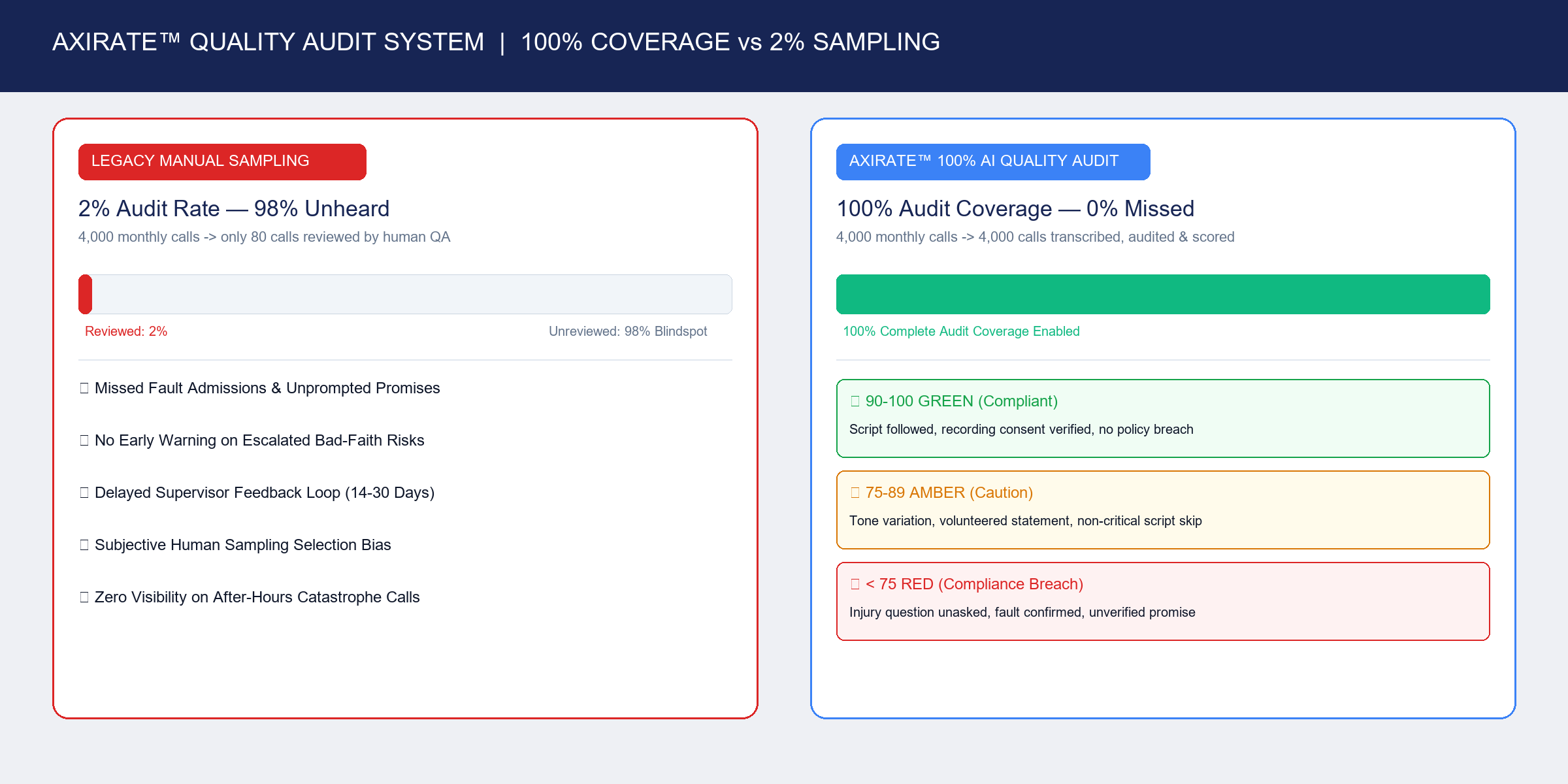
Sampling answers a question you are not being sued over
Run a 2% sample well and you get something genuinely useful: a defensible, trended read on average adjuster behaviour. Coaching scores. A calibration record. Evidence that your program has a quality function at all.
What it structurally cannot produce is an answer to the only question that ever arrives under pressure: “What was said to this customer, on this file, on this date?” A sample is not a smaller version of that answer. It is a different kind of thing.
And the events that turn a routine loss into an expensive one are, by their nature, per-file events:
- A fault or liability statement made on a first-notice call, before anyone had the facts.
- A promise a caller heard — a rental, a timeline, a coverage assurance — that nobody wrote down.
- A required disclosure or consent that was not read before a recorded statement began.
- A recovery signal — a second vehicle, a third party, an employer, a witness — mentioned once and never carried onto the file.
Each of those happens on one call. Draw a sample and the odds you catch a given one are exactly your coverage number. Move the slider above to 2% and you have set the probability of hearing any specific bad moment to two in a hundred — and you have done it on purpose, in a document, years ago.
What changes when the constraint goes away
The reason for sampling was capacity, and capacity is the part that changed. When listening is no longer rationed, the sensible coverage target stops being a budget line and becomes an obvious one: all of them.
Every FNOL call and every recorded statement, transcribed speaker-by-speaker and scored against your own rule sheet — the same standards your QA analysts already apply, applied to the other ninety-something percent. Your team stops being the bottleneck and starts being the reviewers of a flagged list.
The line we do not cross
An audit engine that decides claims would be a liability, not a product. So this one does not decide anything. AxiRate™ confirms or flags — it never adjudicates.
Every flag is a citation: the rule it maps to, the verbatim line, the timestamp. It says “this sentence looks like a fault admission, and here it is.” It does not say who is at fault, what is covered, or what the file is worth. A licensed human being makes every one of those calls, exactly as they do today.
Coverage decisions, liability decisions and reserving stay entirely with your specialists. The audit's only job is to make sure nothing reached them unheard.
It has to learn your program, not ours
No two claims organisations score a call the same way. State language differs, script standards differ, and two reasonable QA leads will disagree about whether a given sentence crossed a line.
So the rule set is yours. It starts from your written standards, and every time a reviewer overturns a flag, that correction trains the matrix. Disagreement is not friction in this system — it is the input. A flag you reject twice is a rule that was wrong for your program, and it stops firing.
Where this sits, honestly
This is not an answering service and it is not a receptionist bot. It belongs to the category your team already knows: conversation intelligence and QA automation — the enterprise tooling that carriers and large TPAs evaluate for exactly this problem.
The difference we are arguing for is narrower and more specific than a feature list: this one is built claims-first. The rule matrix is a claims-handling matrix, not a generic sales-call scorecard with insurance words added. It knows what a recorded statement is, what an intake standard requires, and what a liability admission sounds like at 2 a.m. on a first notice of loss.
And the answering line, if you ever want it, is the add-on — after-hours, weekends, catastrophe overflow. The audit is the product.
The four objections we get, and the honest answers
| What we hear | The answer |
|---|---|
| “We already have a QA team.” | Good — they stay. Nothing here replaces a QA analyst; it replaces the selection step. They stop choosing which two calls to open and start working a flagged queue drawn from all of them. Same people, better input. |
| “Our audio can’t leave our environment.” | Then it doesn’t. Transcription and scoring run inside a closed enclave on your infrastructure, with a carrier-hosted offline option so no call audio and no transcript transits a third party. The security & architecture page covers what your InfoSec team will ask first. |
| “We’re not letting AI touch claim decisions.” | Neither are we. It confirms and flags with citations; a human decides. If a flag is wrong, your reviewer overturns it and the rule set learns. No decision authority is transferred at any point. |
| “Our recordings live in Genesys / Avaya / Five9.” | That is where we read them from, and the finished brief posts back to Guidewire, Duck Creek or your TPA platform under your claim number — on the file, not in another dashboard nobody opens. |
The only honest way to evaluate this
Not a demo built on our data. A demo built on yours.
Send ten of your own recorded FNOL or statement calls and the QA rule sheet you already use. You get back a claim-by-claim audit scored against your standards — every flag citable to a line and a timestamp, every pass explained. Then you do the thing that actually settles it: hand the same ten calls to your best QA analyst and compare.
If the flags are noise, you have lost ten calls’ worth of time and learned something real about the category. There is no payment until you have seen your own calls scored.
Score ten of your own calls
Ten recordings and your rule sheet. A claim-by-claim audit against your own standards comes back before there is any conversation about an engagement. Here is exactly how to send them.
Or hear the intake line answer, right now: (469) 916-6767