 AgentAngel.io™
AgentAngel.io™
AgentAngel.io™
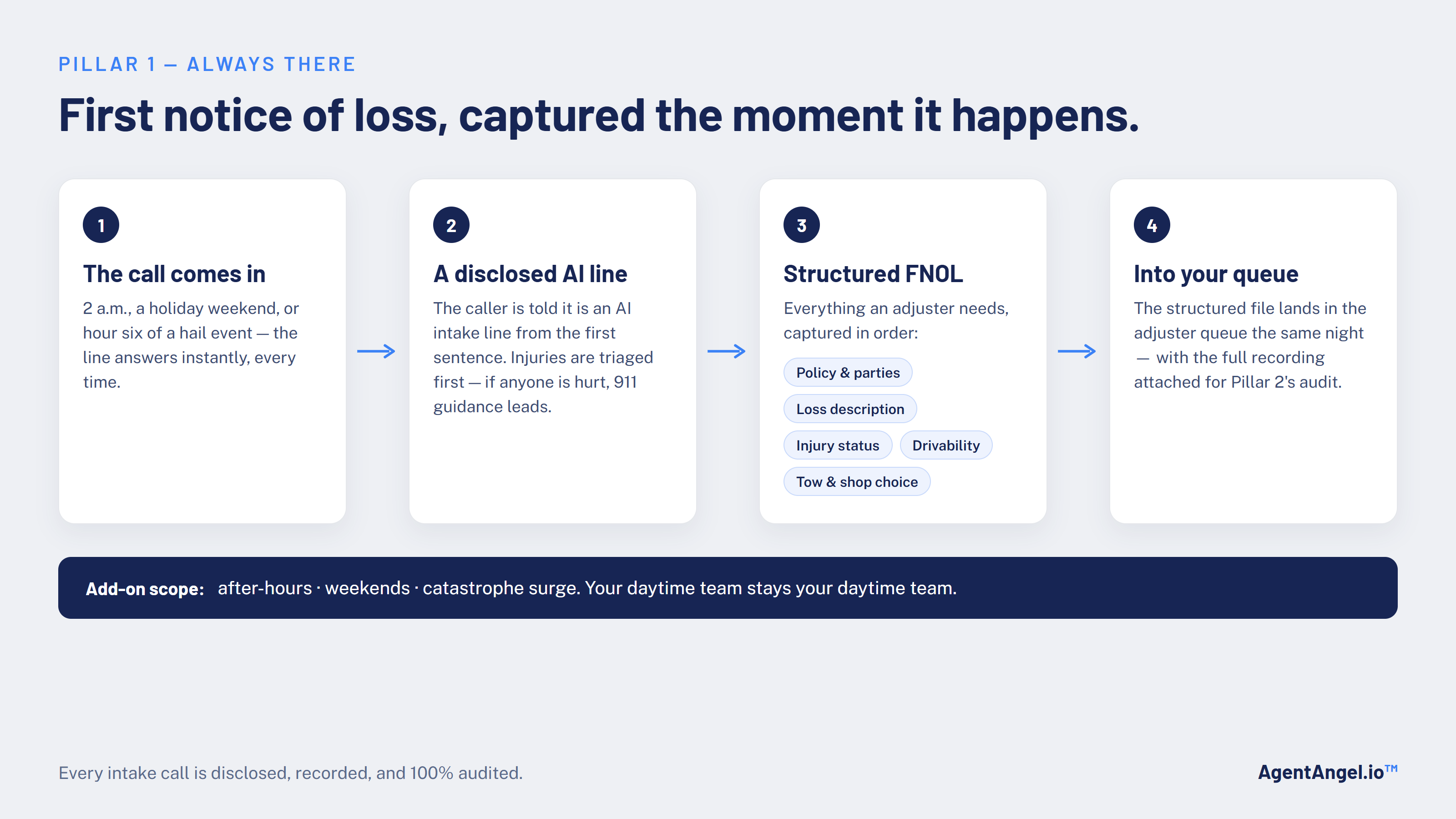
Every call gets a warm, disclosed voice that takes first notice of loss the moment it comes in — nights, weekends, and the hour a catastrophe event floods your queue. It gathers a complete file. It never creates a claim, and it never pretends to be an adjuster.

Many carriers use the first-notice call as the recorded statement instead of phoning the claimant back for an official one. Where that's true, there is no second call to schedule, no callback to chase — the adjuster already has a statement-grade account.
Single-issue, low-dispute losses where a callback statement rarely changes the outcome.
Weather, theft, and non-collision losses with a straightforward narrative.
One vehicle, one driver, no counterparty account to reconcile.
When the insured admits fault during the call itself, the need for a second official statement drops away.
Every call opens with a plain-language AI disclosure, carries your carrier's name, and moves at a pace a caller in a bad moment can actually keep up with.
The caller is told immediately they've reached an AI line, told whose carrier they've reached, and told what happens next.
The caller tells what happened in their own words first. An injury question follows with a human acknowledgement of the answer — never a script that steamrolls past it.
Name spelled back for accuracy, a best daytime number, and explicit consent for a callback and for text messages — captured on the call, not assumed.
A description of the damage, a request for photos of the damage and the scene, and whether a police report was filed.
The caller is told to expect a callback from the adjuster with a claim number and next steps. Anything the caller asks for that isn't ours to promise gets noted for the adjuster — never promised on the call.
A simulated 2 AM emergency claims call, played out exactly as the Angel runs it — FNOL loss report building live on the right.
This is not an overflow-only line. The full first-notice queue can route here, and the value shows up before an adjuster ever picks up the file.
Narrative, injury check, contact and consent, damage detail, photos, and the police-report question — collected the same way, every time.
The system never creates a claim and never issues a claim number. Your adjuster reviews what was gathered, approves claim creation, and assigns it — assignment logic stays entirely yours.
Named catastrophe events — hail, hurricane, flooding — are the exact moment call volume spikes and staff is stretched thinnest. The line holds through the surge without a hold queue forming behind it.
Delivered into your portal as soon as the call ends — nothing to request, nothing to wait on.
Client-side file residency is the default posture, not a footnote — the recordings and transcripts live on infrastructure you control.
Connecting this line into your own claims system is separate work — key setup and the integration itself — and isn't bundled in by default.
Pillar 1 collects a file for a human adjuster to act on. It does not adjudicate, does not determine coverage, and does not issue a claim number. Every unmet request a caller makes is written down for the adjuster — never promised on the call.